
A new pair of glasses can have the right prescription, a beautiful frame, and premium lenses, yet still feel slightly off. You may find yourself tilting your head to read, noticing blur at the edges, or feeling pressure behind your ears by midafternoon. That is why accurate measurements and proper lens fitting matter: your eyewear needs to be made not only for your prescription, but also for your face, frame, posture, and everyday visual demands.
At Sight Care Optometry & Optical, we see eyewear as part of your daily comfort and confidence. Whether you are choosing computer glasses for long workdays, progressives for reading and driving, or durable frames for a child, careful fitting helps your lenses perform the way they were designed to.
Your Prescription Is Only One Part of Clear Vision
An eyeglass prescription tells the lab how much vision correction your eyes need. It may account for nearsightedness, farsightedness, astigmatism, or the added reading power needed in multifocal lenses. But a prescription alone does not specify exactly where the optical center of each lens should sit in front of your eyes.
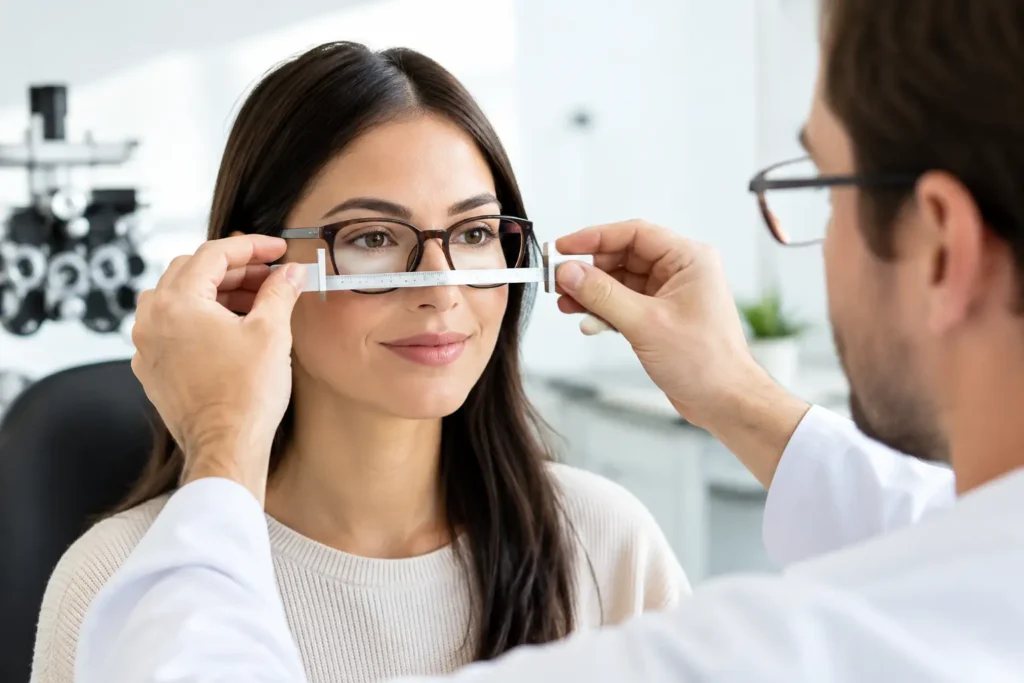
That is where measurements come in. Your pupils are not always centered in the same spot within a frame, and the distance between them varies from person to person. A skilled optical professional measures this carefully so the clearest part of each lens aligns with your natural line of sight.
When lenses are positioned correctly, looking through them feels natural. When they are not, your eyes may work harder to find a clear zone. Some people notice headaches, visual fatigue, distortion, or a sense that their glasses are never quite comfortable. These symptoms can have several causes, so an eye exam is always valuable when vision changes, but lens positioning is an important factor worth checking.
Why Accurate Measurements and Proper Lens Fitting Matter for Every Lens Type
All prescription lenses benefit from accurate measurements, although the details become especially noticeable with stronger prescriptions, progressive lenses, and specialized designs.
Pupillary Distance Helps Center Your Vision
Pupillary distance, often called PD, is the distance between the centers of your pupils. It helps position the optical centers of your lenses where your eyes naturally look. A small error may be less noticeable in a simple, low prescription, but it can affect comfort more significantly with higher prescriptions or more complex lenses.
PD is not always a single, universal number. In some cases, each eye needs its own measurement from the center of the nose. This is called a monocular PD, and it can provide a more precise result when facial symmetry differs from side to side.
Lens Height Is Essential for Progressives and Multifocals
Progressive lenses provide distance, intermediate, and reading vision without the visible lines of traditional bifocals. Their convenience depends on precise placement. The distance portion sits toward the top, computer-range vision is in the middle, and near vision is lower in the lens.
To work well, a progressive lens needs to be measured for the frame while it is sitting properly on your face. Lens height, sometimes called fitting height, identifies where your pupil falls in that frame. If the lenses sit too high, too low, or are mounted in a frame that has shifted, you may struggle to find the right viewing area.
This does not mean every progressive wearer needs the same frame shape or lens design. A person who reads frequently may benefit from a different design than someone who spends more time driving, using dual monitors, or moving between indoor and outdoor spaces. The best choice depends on how you use your eyes, not simply on what is popular.
Frame Position Changes How Lenses Perform
Glasses are three-dimensional, but they are often treated as if they are flat. The angle of the frame, its curve around the face, and its distance from your eyes all influence how lenses line up with your vision.
An optical professional may assess vertex distance, which is the space between the lens and your eye; pantoscopic tilt, or the slight inward tilt of the frame at the bottom; and frame wrap, the curve of the frame around your face. These details are particularly relevant for high prescriptions, progressive lenses, occupational lenses, and wraparound sunglasses.
A frame that slides down your nose can also change your viewing position. It may seem like a minor fit issue, but it can move the lenses away from the measurements used to make them. Regular adjustments help keep your eyewear comfortable and your vision consistent.
The Frame You Love Should Also Support Your Lenses
Style matters. Your glasses are part of how you present yourself at work, at school, and everywhere in between. The good news is that a fashion-forward frame and a well-performing lens are not opposing goals. The key is choosing a frame that works with your prescription and intended lens design.
For example, a very shallow frame may limit the available reading area for some progressive lenses. A large, oversized frame can look fantastic, but may require thoughtful lens selection to manage thickness or edge appearance in stronger prescriptions. A lightweight metal frame may feel barely there, while a bolder acetate frame can offer more stability for certain lenses.
Children need a different kind of consideration. Their frames should fit securely at the bridge, stay level, and sit close enough to the face for their lenses to function properly. A frame that is too wide, too heavy, or constantly slipping can make it harder for a child to adapt to wearing glasses. Since children are active and grow quickly, fit checks are a practical part of ongoing eyewear care.
Comfort Is a Clinical Detail, Not an Afterthought
A proper fit is about more than avoiding nose marks. Frames that pinch, slide, sit unevenly, or press behind the ears are less likely to be worn consistently. That can be frustrating for anyone, but especially for a child, a first-time glasses wearer, or someone adapting to a new multifocal prescription.
During a fitting, the temples, nose pads, frame width, and bridge placement can be adjusted for a secure and balanced feel. The goal is not to make the glasses tight. It is to help them remain in the correct position without creating pressure points.
Small adjustments can also solve issues that develop over time. Heat, daily use, and the simple routine of taking glasses on and off can gradually change a frame’s shape. If one lens suddenly seems lower than the other or your glasses begin slipping more often, an adjustment may be all that is needed.
Premium Lenses Still Need Personalized Fitting
Anti-reflective coatings, blue-light filtering options, photochromic lenses, polarized sun lenses, and thinner high-index materials can all add useful benefits. However, lens features cannot compensate for inaccurate measurements or a poor frame fit.
Think of it this way: premium lens technology can improve clarity, reduce glare, enhance comfort in changing light, or make lenses look thinner. Precise fitting makes sure you are looking through that technology as intended. Both parts matter.
There are trade-offs to discuss, too. A thinner lens material may be beneficial for a stronger prescription, while a more impact-resistant material may be a better priority for an active child. Polarized sunglasses can reduce reflected glare during driving and outdoor activities, though they may make certain digital screens harder to see. Personalized guidance helps match these choices to real life.
What to Expect From a Thoughtful Eyewear Fitting
A complete fitting begins with listening. Your optical professional should ask how you use your glasses, whether you spend long hours on screens, what activities matter most, and what has or has not worked with past eyewear.
Next comes frame selection and measurement. Measurements are taken with the chosen frame on your face, because a number taken without the frame cannot account for its height, angle, or position. Once your glasses arrive, they should be checked on you again. This final appointment is the opportunity to confirm alignment, make comfort adjustments, and explain how to use multifocal or specialized lenses.
If something feels wrong after an adjustment period, speak up. New prescriptions and progressive lenses can require time to adapt, but persistent blur, discomfort, dizziness, or difficulty with a specific task deserves a follow-up. A caring optical team will help determine whether the issue is adaptation, fit, lens design, prescription changes, or another concern that should be assessed by an optometrist.
The right glasses should not ask you to work around them. With precise measurements, a well-chosen frame, and attentive fitting, your eyewear can support clearer sight, greater comfort, and a look that feels like your own.
Note: This posting is for informational purposes only and does not attempt to diagnose or recommend treatment for any condition. Please consult an optometrist if you are experiencing eyesight issues.