
A new prescription is only the starting point. Two people can have the same prescription and walk away with very different visual experiences depending on the lenses they choose. Understanding lens types and technology can help you ask better questions, feel more confident about your options, and select eyewear that works for the way you actually live.
For some people, that means crisp computer vision through a long workday. For others, it means durable lenses for an active child, less glare during driving, or easier reading without constantly moving glasses up and down. The best lens is not simply the most advanced one. It is the one that fits your prescription, eye health, daily tasks, frame choice, and personal preferences.
Understanding Lens Types and Technology for Everyday Vision
Single-vision lenses
Single-vision lenses have one prescription power across the entire lens. They are commonly used for nearsightedness, farsightedness, or astigmatism. If you wear glasses to see the board at school, recognize street signs, or read comfortably, single-vision lenses may be part of your eyewear plan.
They can be made for distance, near tasks, or computer use. That distinction matters. A pair designed for reading is not necessarily comfortable for a full day at a laptop, and distance glasses may not offer ideal clarity at arm’s length. An optometrist can help identify the viewing range that deserves the most support.
Bifocal and progressive lenses
When near vision begins to change with age, usually in the 40s and beyond, it can become harder to focus on menus, phones, labels, and books. This natural change is called presbyopia. Multifocal lenses provide more than one viewing zone in a single pair of glasses.
Traditional bifocals have a visible line separating the distance and near portions of the lens. They remain a practical choice for some wearers, particularly when a clear division between viewing areas is preferred. Progressive lenses offer a more gradual transition from distance vision at the top to intermediate vision in the middle and near vision at the bottom, without a visible line.
Progressives can be an excellent all-day option, but adjustment varies. The sides of the lens may have some softer peripheral vision, especially with stronger prescriptions or smaller frames. Careful measurements, thoughtful frame selection, and a lens design suited to your needs can make a meaningful difference in comfort.
Occupational and computer lenses
A standard progressive lens is designed to help across many distances, but it may not be the most comfortable solution for every desk setup. Occupational lenses are tailored for near and intermediate ranges, such as a computer monitor, keyboard, paperwork, or a workbench.
They often provide a wider, more relaxed viewing area for the distances used indoors. The trade-off is that they are not intended for driving or looking far across a room. Many people who work on screens all day appreciate having a dedicated pair for work alongside their everyday glasses.
Specialized lenses for specific needs
Some visual needs call for more focused solutions. Prism lenses may be prescribed to help align the eyes and reduce symptoms such as double vision or visual strain in certain cases. High-prescription lenses can be designed to reduce thickness and improve appearance. Myopia management lenses for children may be recommended as part of a broader plan intended to help slow myopia progression.
The right recommendation depends on a complete eye examination and a conversation about symptoms and routines. A lens should solve a real visual problem, not add features you do not need.
Lens Materials Affect Comfort, Thickness, and Safety
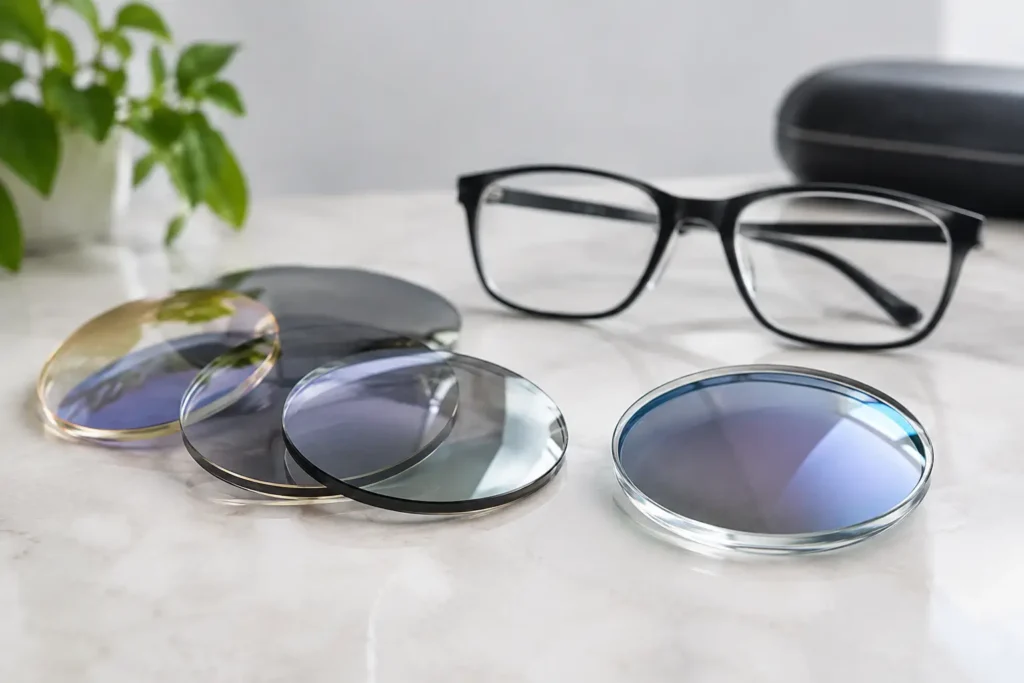
Lens material influences how glasses feel, look, and hold up to daily wear. Standard plastic lenses can work well for lower prescriptions and are often an economical choice. For stronger prescriptions, high-index materials can create thinner, lighter lenses than conventional plastic.
Polycarbonate and Trivex lenses are popular when impact resistance is a priority. They are often considered for children, active lifestyles, and safety-minded eyewear. Polycarbonate is lightweight and impact resistant, while Trivex is also valued for its optical clarity and lighter feel. The best choice can depend on prescription strength, frame style, budget, and how the glasses will be used.
A thinner lens is not always automatically better. Very thin materials may have different visual characteristics, and a well-chosen frame can often improve the look of a lens just as much as the material itself. A knowledgeable optical team can explain these trade-offs clearly before you decide.
Coatings and Treatments That Change the Experience
Many lens technologies are not immediately visible, but they can shape how your glasses perform every day.
An anti-reflective coating reduces reflections on the front and back of the lenses. This can improve the appearance of your glasses in photos, make lenses look clearer to others, and reduce distracting reflections from screens and lights. It can be especially helpful for night driving, although it does not eliminate all glare or make driving in difficult weather risk-free.
Scratch-resistant treatments help lenses stand up better to regular use, but no lens is completely scratch-proof. Proper cleaning matters. Rinsing lenses before wiping them and using a clean microfiber cloth can help prevent tiny particles from marking the surface.
UV protection helps shield the eyes from ultraviolet exposure. Many clear lens materials include UV protection, but it is worth confirming what your lenses provide. For bright outdoor conditions, prescription sunglasses can add comfort by reducing visible light as well as providing UV protection.
Photochromic lenses darken in sunlight and become clearer indoors. They can be convenient for people moving between indoor and outdoor settings, but activation can vary with temperature and light conditions. They also may not darken as much behind a car windshield, which blocks much of the UV light that activates many photochromic lenses.
Polarized sun lenses are especially useful around water, snow, and pavement because they reduce certain reflected glare. They can improve comfort for driving and outdoor activities. However, some people notice that polarized lenses can make certain digital displays harder to see from particular angles. That is worth considering if you regularly rely on dashboard screens or devices outdoors.
Digital Lens Design and Personal Measurements
Modern lens manufacturing can account for much more than a basic prescription. Digital or free-form lens designs use precise calculations to customize the optics across the lens surface. These designs may offer clearer vision in a wider usable area, particularly in progressive lenses and stronger prescriptions.
Accurate measurements are just as important as the lens itself. The position of your pupils, the height of the lenses in the frame, how close the frame sits to your face, and the angle at which it rests can all affect performance. This is why trying on frames and receiving personalized fitting guidance can be so valuable.
Frame choice also has practical consequences. A very shallow frame may limit the room available for a progressive lens. An oversized frame can place more lens material in front of the eyes, which may affect weight or thickness with certain prescriptions. Style and function do not need to compete, but they should be considered together.
How to Choose Lenses That Fit Your Life
Start with your day, not a product name. Think about where you spend your time, how often you use screens, whether you drive at night, what sports or hobbies you enjoy, and whether you need one pair of glasses or several purpose-built pairs.
Parents may want to prioritize durable, impact-resistant lenses for a child, along with regular eye exams that monitor vision development. Adults balancing office work, commuting, and family schedules may benefit from options that reduce glare and support computer use. Older adults may need multifocal designs that make daily tasks easier while maintaining comfortable distance vision.
At Sight Care Optometry & Optical, the goal is to pair clinical guidance with practical optical advice, so your eyewear feels personal rather than generic. Bring up any frustration you have had with previous glasses, whether it is glare, headaches, slipping frames, difficulty adapting to progressives, or lenses that scratch too easily. Those details help guide a better recommendation.
Your lenses should support the moments that matter to you, from reading a bedtime story to seeing clearly on the road home. A careful conversation and the right measurements can turn a prescription into eyewear you genuinely enjoy wearing.
Note: This posting is for informational purposes only and does not attempt to diagnose or recommend treatment for any condition. Please consult an optometrist if you are experiencing eyesight issues.